
 Dry Cat Food
 Cat Wet Food
 Adult Cat Food
 Kitten Food
 Canned Cat Food
 Cat Pouch Food
 Cat Treats
 Cat Litter Scoop
 Cat Litter Box
 Clumping Cat Litter

 Kitten Milk Replacer
 Cat Deworming Products
 Cat Shampoo
 Cat Bathing
 Cat External Care Products
 Cat Hygiene Products
 Cat Cleanup & Odor Control
 Cat Supplement Products
 Cat Toothbrushes
 Puppy Training
 Cat Feeder
 Cat Grooming
 Catnip
 Cat Food Bowl
 Cat Bow Ties
 Cat Collar
 Cat Harnesses
 Cat Scratchers
 Cat Sunglasses
 Puppy Food
 Adult Dog Food
 Dog Toys
 Dog Harnesses
 Dog Shampoo
 Dog Vitamins and Supplements
 Dog External Care Products
 Rabbit Adult Food
 Rabbit Accessories
 Rabbit Junior Food


 Pet Bed, Carrier & House
 Cat Dress & Tshirt
 Pet Houses
Last reviewed: August 2026
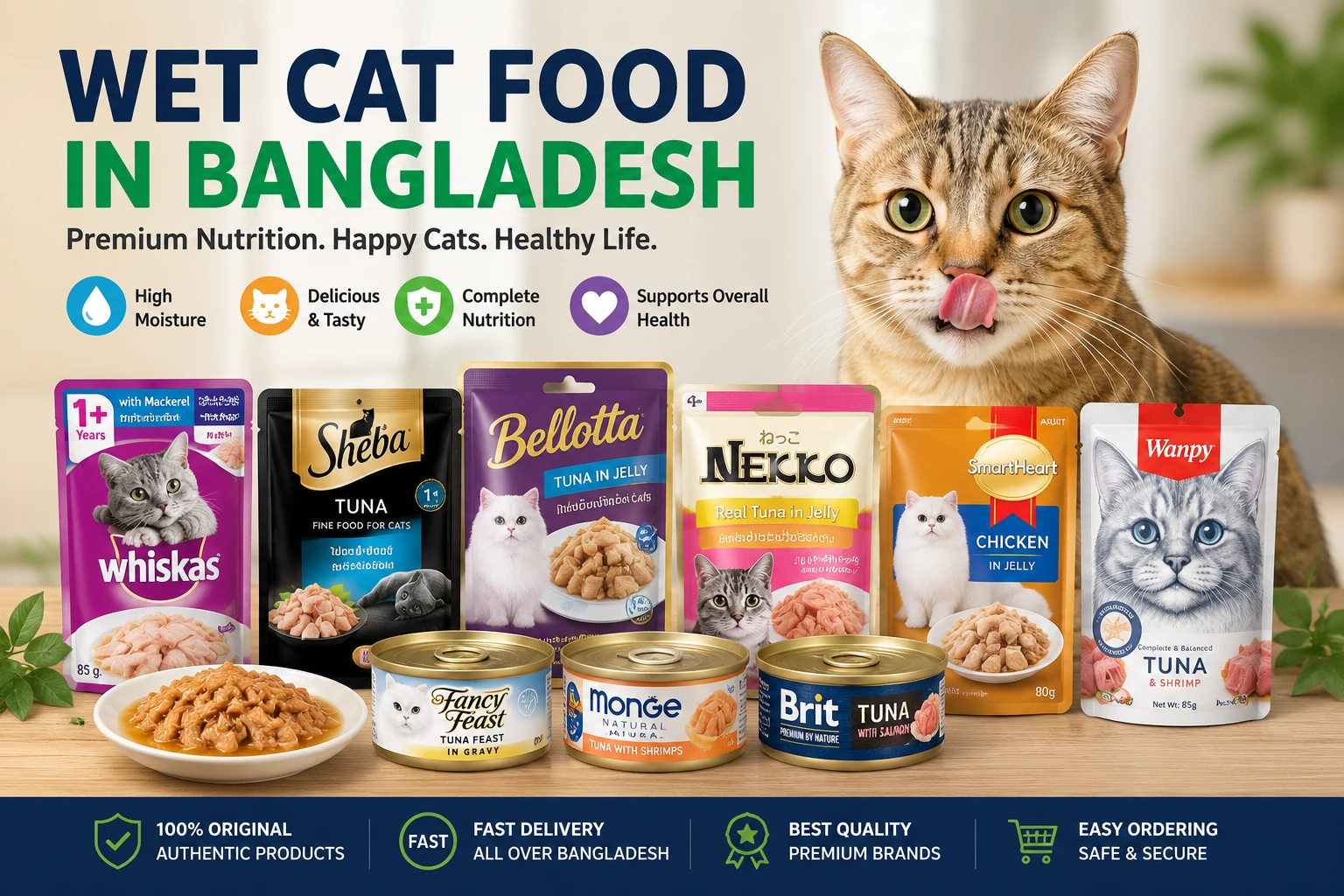
Wet cat food is a high-moisture form of commercially prepared cat food commonly sold in cans, pouches and trays. One of its main differences from dry food is water content. According to the U.S. Food and Drug Administration (FDA), canned pet food typically contains about 75–78% moisture, while dry pet food typically contains about 10–12% moisture.[1]
Wet food may be used as a cat’s main diet when the specific product is formulated as nutritionally complete and appropriate for the cat’s life stage. Some wet foods, treats and toppers are complementary rather than complete, so cat owners should always check the product label before using a food as the sole diet.[2][3]
This guide explains wet cat food moisture, nutrition, hydration, label information, feeding, storage and wet-versus-dry comparisons for cat owners in Bangladesh.
This article provides general educational information and is not a substitute for veterinary diagnosis or treatment. Cats with urinary disease, kidney disease, diabetes, persistent vomiting, unexplained weight loss, food allergies or other medical conditions should be assessed by a qualified veterinarian.
What Is Wet Cat Food?
Wet cat food is commercially prepared cat food with a relatively high water content. Common formats include pâté, loaf, mousse, flakes, chunks in gravy and pieces in jelly or sauce.
FEDIAF describes cans, pouches and trays as common wet pet-food formats. Commercial wet foods are typically prepared by combining recipe ingredients, placing the food in a sealed container and applying controlled heat processing.[3]
- Canned cat food
- Wet food pouches
- Wet food trays
- Pâté or loaf-style foods
- Chunks or flakes in gravy, sauce or jelly
The appearance or texture of a food does not by itself show whether it provides complete nutrition. The nutritional adequacy statement, intended life stage and feeding directions are more useful when evaluating whether a particular product can serve as a cat’s regular diet.
How Much Moisture Is in Wet Cat Food?
The FDA states that canned pet food is typically 75–78% moisture, whereas dry pet food is typically 10–12% moisture.[1]
| Food Format | Typical Moisture |
|---|---|
| Canned/Wet Pet Food | 75–78% |
| Dry Pet Food | 10–12% |
Because wet food contains substantially more water, nutrient percentages printed on wet and dry food labels should not always be compared directly. The FDA explains that Guaranteed Analysis values are generally shown on an as-fed basis, meaning the water in the product is included.[1]
Why Moisture Matters When Comparing Protein
A wet food showing 10% or 11% crude protein on the label is not necessarily lower in protein than a dry food showing 30% or more crude protein. The wet product contains much more water, so a dry-matter calculation is needed when foods with very different moisture contents are compared.[1]
Dry matter % = 100 − moisture %
Nutrient % on a dry-matter basis = (as-fed nutrient % ÷ dry matter %) × 100
For example, a wet food containing 78% moisture has 22% dry matter. If its label lists 11% crude protein, the protein level on a dry-matter basis is approximately 50%.
This calculation is useful for nutritional comparison, but it does not by itself determine whether one food is better than another.
Wet Cat Food and Hydration
Water can come from both drinking and food. Because wet cat food contains substantially more water than dry food, cats eating wet diets can receive a larger proportion of their total daily water intake through their meals.
Controlled research in healthy cats has found higher total water intake when cats consumed high-moisture or wet diets, even though the cats sometimes drank less water directly from their water bowls.[4][5]
A 2026 study that compared 100% dry, mixed wet-and-dry, and 100% wet diets in both research-colony and privately owned cats also found that free drinking-water intake was greatest on the dry diet, while total water intake was greatest on the wet diet.[6]
This distinction is important: a cat that drinks less from a bowl while eating wet food is not necessarily consuming less water overall.
Fresh, clean drinking water should still remain available at all times regardless of whether a cat eats wet food, dry food or a combination of both.
Wet Food, Urine Volume and Urine Concentration
Dietary moisture can influence urinary measurements in healthy cats. In a controlled crossover study, cats consuming a diet containing about 73% moisture had higher total fluid intake and more dilute urine than when they consumed lower-moisture diets.[4]
Another controlled study found that cats fed a wet diet had greater urine volume and lower urine specific gravity than when they were fed a dry diet.[5]
These findings describe effects observed in research involving healthy cats. They do not mean ordinary wet food should be considered a treatment or guaranteed preventive measure for feline urinary disease.
A cat showing difficulty urinating, repeated unsuccessful attempts to urinate, blood in the urine, pain while urinating, unusual vocalization, or inability to pass urine should receive prompt veterinary attention.
Complete vs Complementary Wet Cat Food
Not every can or pouch is designed to provide a cat’s complete daily nutrition.
FEDIAF distinguishes between complete and complementary pet food. Complete pet food is intended to provide the required nutrients in appropriate quantities when fed as directed. Complementary food is intended to form only part of the diet and must be combined appropriately with other food.[3]
For products using U.S.-style AAFCO nutritional adequacy statements, the FDA explains that a food described as “complete and balanced” must substantiate nutritional adequacy through an applicable AAFCO nutrient profile or feeding-trial procedure.[1]
Important for Bangladesh: regulatory wording on imported products can differ depending on the country of manufacture and market. AAFCO terminology is useful for understanding many imported pet foods, but it should not be treated as Bangladesh-specific labelling law.
What to Check on a Wet Cat Food Label
When evaluating packaged cat food, look beyond the front-of-pack marketing claims. AAFCO’s consumer guidance identifies several label components that help explain what a pet food contains and how it is intended to be used.[2]
1. Species
Confirm that the product is specifically intended for cats.
2. Nutritional Adequacy
Look for wording that explains whether the product is intended as a complete diet and which life stage it is formulated for.
3. Guaranteed Analysis
AAFCO guidance identifies crude protein, crude fat, crude fibre and moisture among the core nutritional guarantees commonly shown on pet-food labels.[2]
4. Ingredient List
Ingredients are listed in descending order by weight under AAFCO-style labelling rules.[2] The ingredient list provides useful information, but it should not be used alone to decide whether a food is nutritionally complete.
5. Life Stage
Kittens, adult cats and reproducing cats do not necessarily have identical nutrient and energy requirements. Choose a food whose nutritional adequacy information matches the intended life stage.
6. Feeding Directions
Use the manufacturer’s feeding directions as a starting point, then monitor body weight and body condition. Individual energy requirements vary.
7. Manufacturer or Distributor Information
Check that the manufacturer, distributor or responsible company is clearly identified.
8. Lot Number and Date Information
Keep the original packaging or record the lot number, product name and best-before or expiry information. These details can be useful if a product-quality issue or recall occurs.[7]
Important Nutrients in Cat Food
Cats have species-specific nutritional requirements. A complete diet needs to provide nutrients in appropriate quantities and proportions for the intended life stage.
Protein
Dietary protein provides amino acids needed for normal body functions, growth and tissue maintenance. FEDIAF notes that cats have higher protein requirements than dogs.[8]
When comparing protein percentages in wet and dry foods, remember that moisture differences can make direct as-fed comparisons misleading.
Taurine
Taurine is an essential nutrient for cats. FEDIAF identifies taurine as important for normal feline heart and eye function and notes that cats require a dietary supply.[8]
A nutritionally complete commercial cat food should provide appropriate levels of essential nutrients rather than relying on owners to add supplements without professional guidance.
Fat, Vitamins and Minerals
Dietary fats provide energy and essential fatty acids, while vitamins and minerals support numerous physiological functions. Appropriate amounts and ratios matter; adding supplements to an already complete diet is not automatically beneficial.
Wet Cat Food for Kittens
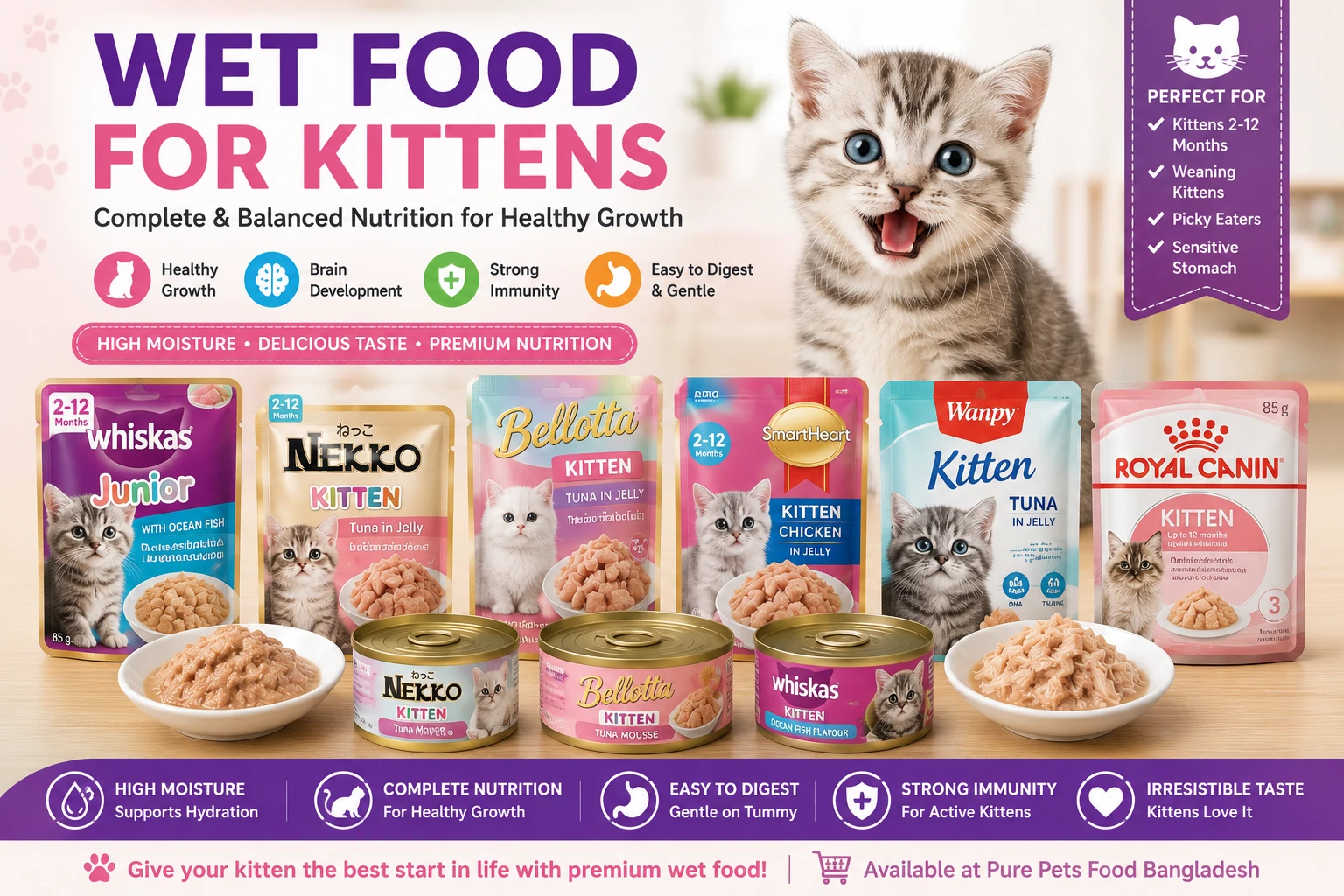
Kittens require nutrition appropriate for growth. If wet food is being used as a kitten’s primary diet, check that the product is formulated as nutritionally adequate for growth or an applicable all-life-stages category.
- Check the nutritional adequacy statement.
- Confirm the intended life stage.
- Follow product-specific feeding directions.
- Monitor growth and body condition.
- Keep fresh drinking water available.
For more general kitten-feeding information, see our Kitten Food in Bangladesh guide.
Wet Food for Adult Cats
For a healthy adult cat, choose a nutritionally complete food appropriate for adult maintenance and feed an amount that supports an appropriate body condition.
Package size alone should not determine portion size. Two wet foods sold in similarly sized pouches can have different calorie densities and feeding recommendations.
Wet Food for Senior Cats
Older cats can differ considerably in body condition, activity, appetite, dental health and medical needs. There is no single wet-food formulation that is automatically appropriate for every senior cat.
Persistent weight loss, increased thirst, increased urination, reduced appetite, repeated vomiting or other significant changes in an older cat should be discussed with a veterinarian rather than managed only by changing food.
Wet Cat Food vs Dry Cat Food
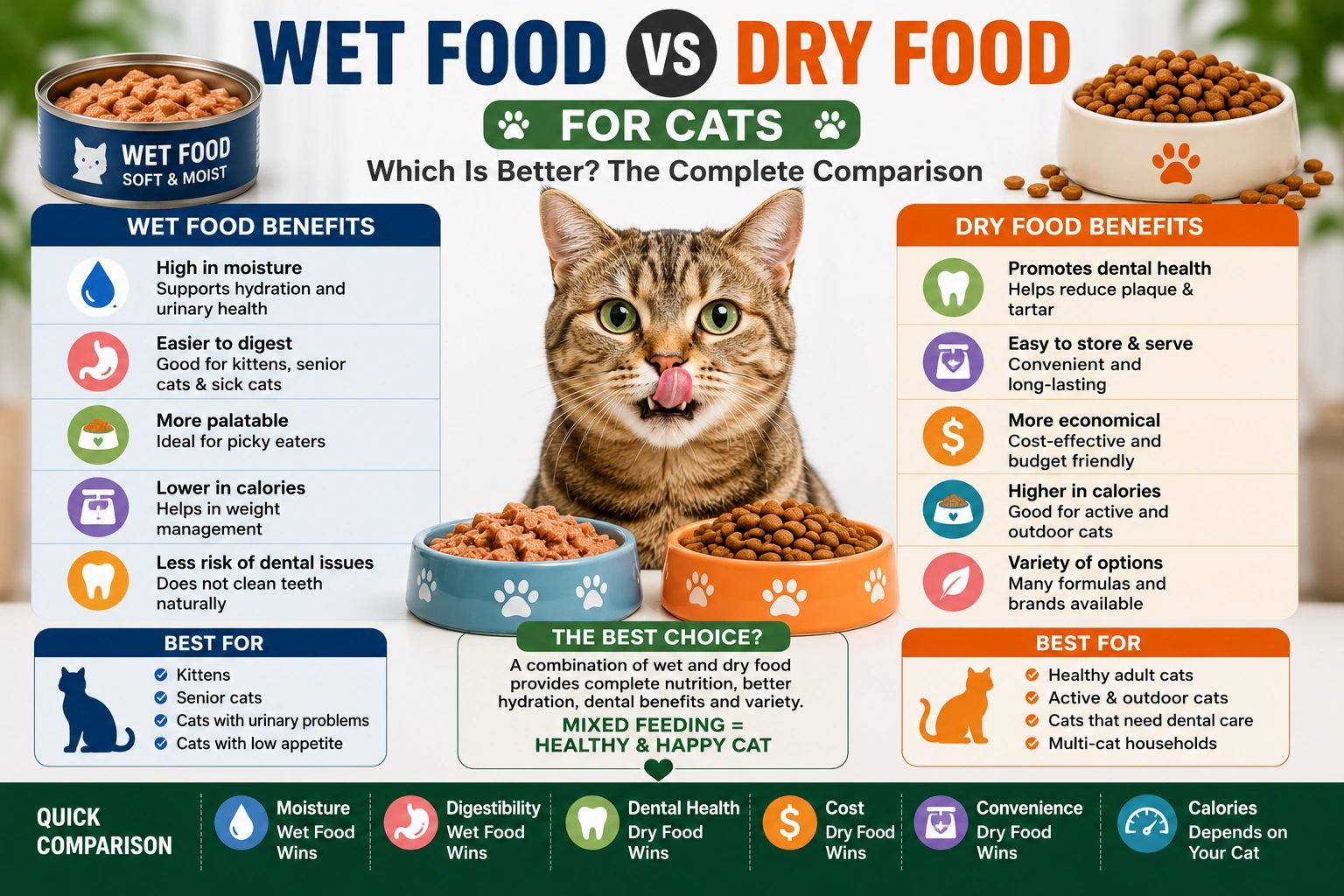
Neither wet nor dry food is automatically the best format for every healthy cat. Both can be nutritionally complete when properly formulated.
| Feature | Wet Cat Food | Dry Cat Food |
|---|---|---|
| Typical moisture | About 75–78% for canned pet food | About 10–12% |
| Dietary water contribution | Higher | Lower |
| Texture | Soft/moist | Kibble |
| After opening | Unused portions require prompt refrigeration or disposal | Follow dry-storage instructions |
| Nutritionally complete options available | Yes | Yes |
| Comparing nutrient percentages | Account for moisture when comparing foods with substantially different water content | |
If you want to compare dry-food options separately, see our Dry Cat Food in Bangladesh guide.
Can Wet and Dry Cat Food Be Mixed?
Wet and dry food can be used together when the overall feeding plan remains nutritionally appropriate.
- Check whether the main foods are nutritionally complete for the intended life stage.
- Consider the calories provided by both foods.
- Do not automatically feed a full wet ration plus a full dry ration.
- Introduce major dietary changes gradually when appropriate.
- Monitor body weight and body condition.
- Keep fresh drinking water available.
For broader feeding information, read our Cat Feeding Guide.
How Much Wet Cat Food Should a Cat Eat?
There is no reliable universal rule such as “one pouch per day” that applies to every cat and every product.
The appropriate quantity depends on factors including:
- Body weight
- Body condition
- Age and life stage
- Activity level
- Neuter status
- Health status
- Calorie density of the food
- Whether dry food, treats or other foods are also being fed
Use the feeding directions on the specific food as an initial guide and adjust according to body condition and professional veterinary advice when necessary.
How Often Should Wet Cat Food Be Fed?
Meal frequency can vary with age, routine, lifestyle, individual preference and medical needs. The package feeding guide normally provides a recommended total daily amount, which can be divided into appropriate meals.
Kittens generally require a feeding approach appropriate for growth, while adult feeding schedules may be different. For an individual cat, especially one that is underweight, overweight, pregnant, nursing or medically affected, veterinary advice is preferable to a generic online meal schedule.
Grain-Free Wet Cat Food
“Grain-free” describes an ingredient characteristic; it does not by itself prove that a food is nutritionally superior or more appropriate for a particular cat.
If a grain-free product is intended to be a cat’s primary diet, nutritional adequacy and suitability for the cat’s life stage remain more important considerations than the grain-free label alone.
How to Compare Two Wet Cat Foods
Step 1: Check Whether the Food Is Complete or Complementary
Do not assume every pouch is intended as a complete meal.
Step 2: Check the Intended Life Stage
Choose a formulation appropriate for the cat’s age and nutritional requirements.
Step 3: Check Calorie Information and Feeding Directions
Similar package sizes do not necessarily provide the same amount of energy.
Step 4: Check Moisture
Moisture is especially important when comparing wet food with a lower-moisture food.
Step 5: Compare Nutrients on an Appropriate Basis
When moisture differs substantially, use a dry-matter comparison rather than relying only on as-fed percentages.
Step 6: Consider the Individual Cat
Body condition, health, tolerance, appetite and veterinary recommendations can affect which food is suitable.
Choosing Wet Cat Food in Bangladesh
Wet cat food sold in Bangladesh includes products manufactured in different countries and under different labelling systems. Instead of choosing only by brand popularity or marketing language, examine the individual product package.
- Confirm the product is intended for cats.
- Check the life stage.
- Look for nutritional adequacy information.
- Read the Guaranteed Analysis or equivalent nutrient declaration.
- Check the ingredient list.
- Read the feeding directions.
- Check the manufacturer or distributor.
- Check the lot or batch number.
- Check the best-before or expiry information.
- Inspect cans and pouches for leakage, swelling or serious damage.
- Follow the storage instructions printed on the product.
Terms such as “premium,” “natural,” “high meat,” or “best” should not replace an assessment of nutritional adequacy and the actual product label.
How to Store Wet Cat Food Safely
The FDA recommends storing unopened canned pet food in a cool, dry place. Unused or leftover canned and pouched pet food should be promptly refrigerated or discarded.[7]
The FDA also recommends keeping the refrigerator at 40°F (about 4°C) or below and washing and drying pet-food bowls and serving utensils after use.[7]
- Keep unopened cans and pouches in a cool, dry place.
- Keep the original product information where possible.
- Do not use leaking, swollen or seriously damaged packages.
- Refrigerate unused opened wet food promptly.
- Keep refrigerated leftovers covered.
- Follow the manufacturer’s instructions for how long opened food should be kept.
- Use clean serving utensils.
- Wash and dry food bowls after use.
- Wash water bowls regularly and provide fresh water.
Common Mistakes When Feeding Wet Cat Food
Assuming Every Wet Food Is a Complete Diet
Some products are complementary foods or treats. Check the label before using a product as the main diet.
Comparing Wet and Dry Protein Percentages Directly
Large moisture differences can make as-fed percentages misleading. Use dry-matter values for a more meaningful comparison.
Overfeeding
Do not assume a small pouch contains too little food based only on its physical size. Consider calorie content and total daily intake.
Treating Wet Food as a Medical Treatment
Dietary moisture can affect total water intake and urinary measurements, but it does not replace diagnosis or treatment for urinary, kidney or other medical diseases.
Ignoring Product Storage Instructions
Opened wet food is perishable. Refrigerate or discard leftovers promptly according to safety guidance and product-specific instructions.
Choosing Food Only by Brand or Price
Price, brand recognition and packaging do not establish whether a product is nutritionally suitable for an individual cat.
Frequently Asked Questions About Wet Cat Food
What percentage of wet cat food is water?
The FDA reports that canned pet food typically contains about 75–78% moisture.[1] Individual products can vary, so check the moisture value on the specific label.
Does wet cat food help increase total water intake?
Research in healthy cats has found higher total water intake with high-moisture or wet diets compared with lower-moisture diets in several controlled settings.[4][5][6]
Does a cat eating wet food still need drinking water?
Yes. Fresh drinking water should remain available regardless of diet format.
Is every wet cat food complete and balanced?
No. Some foods are complete diets while others are complementary foods, treats or toppers. Always check the nutritional adequacy information.[1][3]
Can kittens eat wet cat food?
Yes, provided the product is formulated as nutritionally appropriate for growth or the relevant life stage.
Is wet food better than dry food?
Neither format is automatically best for every cat. Wet food supplies considerably more water through the diet, while both wet and dry foods can provide complete nutrition when appropriately formulated.
Can wet and dry cat food be mixed?
Yes. When mixed feeding is used, consider the combined calories and nutritional adequacy of the overall diet rather than giving the full recommended quantity of both foods.
Does wet food prevent urinary disease?
It should not be described as a guaranteed preventive treatment. Higher dietary moisture can affect total water intake, urine volume and urine concentration in healthy cats, but urinary diseases can have multiple causes and require veterinary assessment when symptoms occur.[4][5]
How long can opened wet cat food be stored?
Follow the manufacturer’s instructions for the individual product. FDA guidance recommends promptly refrigerating or discarding unused canned and pouched pet food and keeping refrigerated food at 40°F (about 4°C) or below.[7]
Key Takeaways
- Canned pet food typically contains about 75–78% moisture, according to the FDA.
- Dry pet food typically contains about 10–12% moisture.
- Account for moisture when comparing nutrient percentages between wet and dry foods.
- Wet diets can contribute substantially to a cat’s total daily water intake.
- Check whether a wet food is complete or complementary.
- Choose food appropriate for the cat’s life stage.
- Read feeding directions and monitor body condition rather than relying on a universal portion chart.
- Keep fresh drinking water available.
- Refrigerate unused opened wet food promptly.
- Seek veterinary care for medical symptoms rather than relying on general feeding information.
Related Cat Feeding Guides
Editorial Disclosure
Pure Pets Food is a commercial pet-products retailer in Bangladesh. This article is published as an educational resource about wet cat food, moisture, nutrition, labelling, feeding and storage.
No specific wet cat food brand is ranked as nutritionally superior in this guide. Product availability, price or sale by Pure Pets Food should not be interpreted as evidence that a particular food is suitable for every cat.
Where medical or nutritional claims are discussed, the article links to regulatory guidance or published research so readers can review the underlying source.
References
- U.S. Food and Drug Administration (FDA). “Complete and Balanced” Pet Food. Information on nutritional adequacy, as-fed versus dry-matter comparisons, and typical moisture levels of canned and dry pet foods.
- Association of American Feed Control Officials (AAFCO). Reading Labels. Consumer guidance covering Guaranteed Analysis, ingredients, nutritional adequacy, life stages and feeding directions.
- FEDIAF EuropeanPetFood. How Wet Pet Food Is Made. Information on wet-food formats and the distinction between complete and complementary pet food.
- Buckley CMF, Hawthorne A, Colyer A, Stevenson AE. Effect of dietary water intake on urinary output, specific gravity and relative supersaturation for calcium oxalate and struvite in the cat. British Journal of Nutrition.
- Alexander JE, Colyer A, Morris PJ. The effect of changing the moisture levels of dry extruded and wet canned diets on physical activity in cats. Includes measurements of total water intake, dietary water intake, urine volume and urine specific gravity.
- Water intake and consumption behavior of colony and privately-owned healthy domestic cats fed 100% dry, 50% dry and 50% wet, and 100% wet diets. PubMed record. Published 2026.
- U.S. Food and Drug Administration (FDA). Proper Storage of Pet Food & Treats. Guidance on storing unopened food, refrigerating opened canned and pouched foods, and cleaning bowls and utensils.
- FEDIAF EuropeanPetFood. Nutritional Requirements. General information on feline protein, taurine, vitamins and essential fatty-acid requirements.


