

 Dry Cat Food
 Cat Wet Food
 Adult Cat Food
 Kitten Food
 Canned Cat Food
 Cat Pouch Food
 Cat Treats
 Cat Litter Scoop
 Cat Litter Box
 Clumping Cat Litter

 Kitten Milk Replacer
 Cat Deworming Products
 Cat Shampoo
 Cat Bathing
 Cat External Care Products
 Cat Hygiene Products
 Cat Cleanup & Odor Control
 Cat Supplement Products
 Cat Toothbrushes
 Puppy Training
 Cat Feeder
 Cat Grooming
 Catnip
 Cat Food Bowl
 Cat Bow Ties
 Cat Collar
 Cat Harnesses
 Cat Scratchers
 Cat Sunglasses
 Puppy Food
 Adult Dog Food
 Dog Toys
 Dog Harnesses
 Dog Shampoo
 Dog Vitamins and Supplements
 Dog External Care Products
 Rabbit Adult Food
 Rabbit Accessories
 Rabbit Junior Food


 Pet Bed, Carrier & House
 Cat Dress & Tshirt
 Pet Houses

Last reviewed: August 2026
Cats regularly swallow loose hair while grooming themselves. Most swallowed hair passes through the gastrointestinal tract, but some can remain in the stomach and form a compact mass commonly called a hairball or trichobezoar.[1]
The Merck Veterinary Manual notes that cats ingest loose hair while grooming and that long-haired breeds have a greater risk of hairball problems. Frequent brushing can reduce the amount of loose fur available to be swallowed.[1]
Occasional hairball vomiting is widely recognized by cat owners, but frequent hairballs should not automatically be considered normal. A veterinary review notes that repeated hairball elimination, particularly in short-haired cats, may sometimes be associated with increased hair ingestion or altered gastrointestinal function caused by an underlying condition.[2]
This guide explains how hairballs form, which cats may be more susceptible, what scientific evidence says about dietary fibre and hairball-control foods, the role of grooming, and when veterinary assessment is appropriate.
This article provides general educational information and is not a substitute for veterinary diagnosis or treatment. Repeated vomiting, persistent retching, loss of appetite, abdominal discomfort or other ongoing symptoms should be assessed by a veterinarian.
What Is a Hairball?

A hairball is a mass of swallowed hair that accumulates in the gastrointestinal tract. Veterinary literature commonly uses the term trichobezoar for a mass formed from ingested hair.
According to the Merck Veterinary Manual, cats swallow loose hair from their coats as they groom. Hair is not digested normally and can collect together in the stomach. Cats often vomit these accumulations, although in some cases a dense mass can remain in the gastrointestinal tract.[1]
Why Do Cats Get Hairballs?
Hair ingestion is closely connected with normal feline grooming behaviour. Cats clean their coats by licking, and loose fur can be swallowed during that process.[1]
Normally, swallowed hair can move through the gastrointestinal tract and leave the body in the faeces. Hairball problems occur when enough hair accumulates to form a compact mass rather than passing normally.
Several factors may influence how much hair is swallowed or how efficiently it moves through the gastrointestinal tract. These can include coat length, shedding, grooming behaviour and gastrointestinal health.[2]
Are Cats Especially Prone to Hairballs?
Cats are particularly associated with hairballs because grooming by licking naturally results in ingestion of loose fur. The Merck Veterinary Manual specifically identifies self-grooming and swallowed loose hair as the mechanism by which feline hairballs form.[1]
This does not mean that every cat will regularly vomit hairballs. Frequency varies between individual cats, and recurrent episodes may warrant further investigation.[2]
Are Long-Haired Cats at Greater Risk?
Long-haired cats can ingest larger quantities of fur during grooming. Merck identifies long-haired breeds as being at greater risk of hairball problems.[1]
A veterinary case series describing intestinal obstruction caused by trichobezoars involved five cats, four of which were long-haired. The authors identified long hair among several possible predisposing factors, while also noting other conditions such as flea-allergy dermatitis and inflammatory bowel disease.[5]
Because that publication was a small case series, it should not be interpreted as evidence that every long-haired cat will develop gastrointestinal obstruction. It does, however, demonstrate that swallowed hair can occasionally cause clinically important complications.[5]
Are Frequent Hairballs Normal?
Hairballs are commonly reported in domestic cats, but veterinary literature cautions against automatically treating frequent hairball vomiting as normal behaviour.
A review published in the Journal of Feline Medicine and Surgery reported that frequent hairball elimination in many short-haired cats can be associated with conditions that increase fur ingestion or alter gastrointestinal motility. Examples discussed in the review include itchy skin disease, flea infestation and dietary intolerance.[2]
For that reason, the frequency and context matter more than simply whether a cat has ever produced a hairball.
When Should a Cat With Hairballs See a Veterinarian?
Merck recommends veterinary assessment when a cat has frequent hairballs or repeated vomiting because another medical problem may be responsible.[1]
Veterinary advice is particularly important when hairball-like episodes occur together with signs such as:
- Repeated or persistent vomiting
- Repeated retching without producing a hairball
- Reduced or absent appetite
- Marked lethargy
- Abdominal discomfort
- Constipation or difficulty passing stool
- Unexplained weight loss
- A major change in grooming behaviour
These signs are not specific to hairballs and can occur with other gastrointestinal or medical conditions.
Can Hairballs Cause Intestinal Obstruction?
Most swallowed hair does not lead to a serious obstruction, but intestinal trichobezoars have been documented in cats.
A published case series described five cats with small-intestinal trichobezoars that produced partial or complete intestinal obstruction.[5]
Merck similarly notes that an accumulated hairball can occasionally remain in the gastrointestinal tract, harden and cause irritation or obstruction.[1]
Serious obstruction is not the usual outcome of grooming-related hair ingestion, but persistent symptoms should therefore not be ignored.
Can Diet Help With Hairball Management?
Some commercial cat foods are formulated specifically for hairball management, often using dietary fibre. However, scientific evidence does not support the simple claim that every high-fibre food works equally well for every cat.
Merck notes that some commercial diets and treats are formulated to help manage hairball formation.[1] Research on specific fibre formulations has produced different results depending on the diet, fibre source and cats studied.
Evidence From Long-Haired Cats
A controlled study involving adult short- and long-haired cats evaluated diets containing different total dietary fibre levels together with psyllium. In long-haired cats, diets containing 11% or 15% total dietary fibre increased the quantity of hair eliminated in the faeces compared with the lower-fibre control diet.[3]
The researchers reported increases in faecal hair excretion of approximately 81% and 113% for the two higher-fibre diets in the long-haired group during the study period. The same effect was not observed in the short-haired cats.[3]
The study was short-term and was conducted outside the moulting season. It was also conducted by researchers affiliated with the Royal Canin Research Center, which should be considered when interpreting the findings.[3]
Not Every Fibre Source Shows the Same Effect
A separate controlled study from researchers at Universidade Estadual Paulista evaluated beet pulp in adult short-haired cats. Beet pulp altered faecal production and gastrointestinal transit time but did not significantly change the number or size of trichobezoars eliminated in the faeces.[4]
Together, these studies suggest that hairball-related effects cannot be predicted simply from a product being described as “high fibre.” Fibre type, amount, coat length and other factors may influence the result.[3][4]
What Is Hairball Control Cat Food?
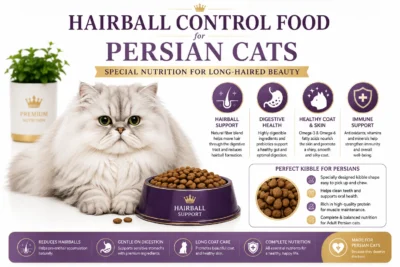
Hairball control cat food is a commercial diet marketed or formulated to assist with the management of swallowed hair. Many such foods contain additional or specifically selected sources of dietary fibre.
The proposed nutritional approach is to encourage swallowed hair to continue through the gastrointestinal tract and be eliminated in the faeces rather than accumulating in the stomach. Scientific studies show that this effect can occur with some formulations, particularly in certain long-haired cats, but it has not been demonstrated consistently with every fibre source or group of cats.[3][4]
What to Check When Choosing Hairball Control Cat Food
Hairball claims should not be the only consideration when choosing a cat’s regular food. The overall diet still needs to be appropriate for the cat’s species, life stage and nutritional requirements.
AAFCO consumer guidance recommends checking the nutritional adequacy statement, Guaranteed Analysis, ingredient list, life-stage information and feeding directions on pet-food labels.[6]
1. Nutritional Adequacy
If the product will be used as the cat’s main diet, check whether it is labelled as complete and balanced for the appropriate life stage rather than as a treat or supplemental product.[6]
2. Intended Life Stage
Many dedicated hairball diets are intended for adult maintenance. Do not assume that an adult hairball-control formula is nutritionally appropriate for a growing kitten.
3. Fibre Information
Hairball diets can use different fibre sources and amounts. Research indicates that different fibre formulations can produce different outcomes, so the presence of fibre alone does not guarantee a particular effect.[3][4]
4. Feeding Directions
Follow the feeding directions for the specific product and monitor body weight and body condition. Feeding recommendations are starting points and can require adjustment for individual cats.[6]
5. Individual Tolerance
A diet that suits one cat may not suit another. Persistent vomiting, diarrhoea, constipation, appetite changes or other gastrointestinal signs should be discussed with a veterinarian rather than managed only by repeatedly changing food.
Choosing Hairball Control Cat Food in Bangladesh
Cat foods sold in Bangladesh may be manufactured under different national labelling systems. Product availability and formulations can also change over time.
Instead of choosing a food solely because it is described as “premium,” “hairball care,” or “best,” examine the individual package and consider:
- Whether it is intended for cats
- Whether it is a complete food or a supplemental product
- The intended life stage
- The nutritional adequacy statement where applicable
- The Guaranteed Analysis or equivalent nutrient declaration
- Fibre ingredients and formulation
- Feeding directions
- Manufacturer or distributor information
- Lot or batch information
- Best-before or expiry information
A higher price or more prominent marketing claim does not by itself establish greater effectiveness for hairball management.
Does Regular Brushing Help Reduce Hairballs?
Yes, brushing has a straightforward role in reducing the amount of loose fur available for a cat to swallow.
The Merck Veterinary Manual specifically recommends frequent brushing as a way to limit the amount of loose hair swallowed during grooming.[1]
Brushing is especially relevant for cats with longer coats or heavy shedding. The appropriate grooming frequency depends on the individual coat and how readily mats or loose fur develop.
Can Excessive Grooming Increase Hair Ingestion?
Anything that substantially increases grooming can also increase the opportunity to ingest fur. A veterinary review of feline hairballs identifies itchy skin disease and flea infestation among conditions that can increase fur ingestion and contribute to recurrent hairball problems.[2]
Therefore, a cat that suddenly begins grooming much more than usual may need assessment of the underlying reason rather than only a change to hairball food.
Does Wet Food Prevent Hairballs?
Wet food contains more water than dry food, but moisture content alone should not be presented as a proven hairball-prevention treatment.
The research cited in this guide focuses mainly on grooming, hair ingestion and specific dietary fibre interventions rather than demonstrating that wet food by itself prevents hairballs.
Fresh drinking water should remain available regardless of diet format.
For evidence-based information about moisture and wet food, see our Wet Cat Food in Bangladesh guide.
Are Hairball Gels and Pastes Necessary?
Hairball gels, pastes and other supplemental products are sold for feline hairball management, but they should not automatically be considered necessary for every cat.
Because formulations differ and repeated hairballs can sometimes reflect another problem, consult a veterinarian before routinely giving medications, lubricants or supplements—particularly when a cat has persistent vomiting or other gastrointestinal symptoms.
Practical Hairball Management
A practical approach focuses on reducing unnecessary hair ingestion while paying attention to signs that could indicate another condition.
- Brush the coat regularly to remove loose hair.[1]
- Pay attention to sudden increases in grooming.
- Address flea or skin problems with appropriate veterinary care.
- Choose a nutritionally appropriate main diet.
- Do not assume every fibre source has the same hairball effect.[3][4]
- Keep fresh drinking water available.
- Seek veterinary advice for frequent vomiting or persistent hairball-like episodes.[1][2]
Common Hairball Myths
Myth: Frequent Hairballs Are Always Normal
Repeated hairballs can sometimes accompany conditions that increase grooming or interfere with normal gastrointestinal function, so frequency matters.[2]
Myth: Every High-Fibre Food Prevents Hairballs
Different studies have produced different results with different fibre formulations and cat populations. A higher-fibre psyllium-containing diet increased faecal hair excretion in long-haired cats in one study, while beet pulp did not change trichobezoar excretion in another study of short-haired cats.[3][4]
Myth: Food Alone Solves Every Hairball Problem
Grooming, coat length, skin disease, gastrointestinal health and diet can all be relevant. Regular brushing and investigation of recurrent symptoms may be as important as food selection.[1][2]
Frequently Asked Questions About Hairballs in Cats
Why do cats get hairballs?
Cats swallow loose fur while grooming themselves. Some swallowed hair can accumulate in the gastrointestinal tract and form a hairball or trichobezoar.[1]
Are long-haired cats more likely to develop hairballs?
Long-haired breeds are identified by the Merck Veterinary Manual as having greater hairball risk.[1]
Do hairball control foods really work?
Some dietary fibre formulations have shown measurable effects on faecal hair excretion, particularly in long-haired cats, but results are not uniform across studies or fibre sources.[3][4]
Does fibre help cats pass swallowed hair?
It can in some circumstances. One controlled study found substantially greater faecal hair excretion in long-haired cats fed higher-fibre diets containing psyllium, but the same effect was not seen in the short-haired cats studied.[3]
Does beet pulp prevent hairballs?
A controlled study in adult short-haired cats found that beet pulp did not significantly change the number or size of faecal trichobezoars, illustrating that different fibre sources should not be assumed to have identical effects.[4]
Can brushing help?
Yes. Merck recommends frequent brushing to remove loose fur and reduce the amount of hair available for a cat to swallow during grooming.[1]
Can hairballs become dangerous?
Serious complications are uncommon, but intestinal obstruction caused by feline trichobezoars has been documented in veterinary literature.[5]
When should I contact a veterinarian?
Veterinary assessment is appropriate when hairballs or vomiting occur frequently, when repeated retching produces nothing, or when symptoms such as appetite loss, lethargy, constipation or weight loss occur.[1][2]
Key Takeaways
- Cats swallow loose fur as part of normal grooming.
- Swallowed fur can accumulate into a hairball or trichobezoar.
- Long-haired cats may be at greater risk of hairball problems.
- Frequent hairballs should not automatically be assumed to be normal.
- Regular brushing reduces loose fur available for ingestion.
- Some fibre-based diets can increase faecal hair elimination, but results vary according to formulation and the cats studied.
- Not every high-fibre food has demonstrated the same hairball effect.
- Hairballs can rarely contribute to gastrointestinal obstruction.
- Persistent vomiting or other ongoing symptoms require veterinary assessment.
Related Cat Care Guides
Editorial Disclosure
Pure Pets Food is a commercial pet-products retailer in Bangladesh. This article is published as an educational resource about feline hairballs, grooming, dietary fibre and hairball-management strategies.
No cat-food brand is ranked or described as universally superior in this guide. Product availability or sale by Pure Pets Food should not be interpreted as evidence that a particular product is appropriate for every cat.
Where veterinary or nutritional claims are discussed, links to veterinary references and peer-reviewed research are provided so readers can review the underlying evidence.
References
- Merck Veterinary Manual. Managing Hairballs in Cats. Veterinary guidance on grooming-related hair ingestion, hairball formation, long-haired cats, brushing and indications for veterinary assessment.
- Cannon M. Hair balls in cats: a normal nuisance or a sign that something is wrong? Journal of Feline Medicine and Surgery. Review of feline hairballs, recurrent hairball symptoms and potential underlying contributing conditions.
- Weber M, Sams L, Feugier A, Michel S, Biourge V. Influence of the dietary fibre levels on faecal hair excretion after 14 days in short and long-haired domestic cats. Veterinary Medicine and Science. Controlled study examining psyllium-containing diets with different total dietary fibre levels in short- and long-haired cats.
- Loureiro BA, Monti M, Pedreira RS, et al. Beet pulp intake and hairball faecal excretion in mixed-breed shorthaired cats. Journal of Animal Physiology and Animal Nutrition. Controlled study evaluating beet pulp and faecal trichobezoar excretion in adult short-haired cats.
- Barrs VR, Beatty JA, Tisdall PLC, Hunt GB, Gunew M. Intestinal obstruction by trichobezoars in five cats. Journal of Feline Medicine and Surgery. Case series documenting partial or complete intestinal obstruction associated with feline trichobezoars.
- Association of American Feed Control Officials (AAFCO). Reading Labels. Consumer guidance on nutritional adequacy statements, life stages, Guaranteed Analysis, ingredients and feeding directions.


